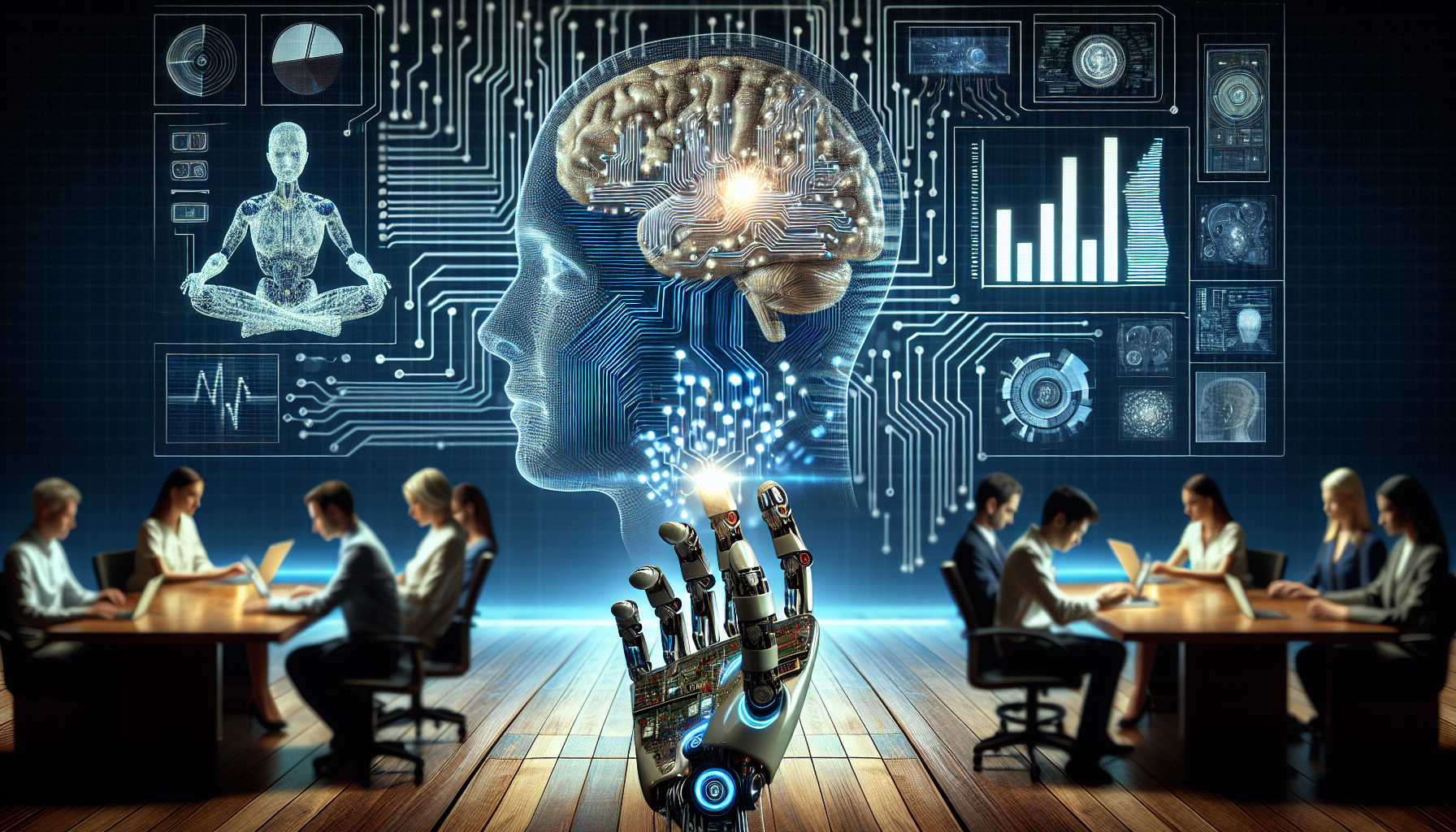
The Evolution of Artificial Intelligence: From Concept to Reality-A Technical Comparative Analysis
April 18, 2026
Artificial Intelligence (AI), once a speculative concept confined to the realm of science fiction, has steadily matured into a pivotal component of modern technology. This transformation is not merely a linear progression but a complex, multifaceted evolution that merits a detailed exploration. By examining the trajectory of AI from its conceptual origins to its current applications, we can better appreciate how foundational theories have been actualized into practical, groundbreaking innovations.
AI's origins are deeply rooted in philosophical inquiries about the nature of intelligence and computation. The initial theoretical framework was inspired by mathematical logic and theories of computation, which posited that machines could simulate any conceivable process of formal reasoning. This hypothesis served as a catalyst for early AI research, where the primary objective was to develop algorithms capable of performing tasks that, if done by humans, would be considered intelligent.
During the inception phase, AI was characterized by rule-based systems and symbolic reasoning. These systems relied heavily on predefined rules and logic to process information, embodying the idea of "good old-fashioned AI" or GOFAI. The limitations of this approach became apparent as researchers attempted to scale these systems to solve complex real-world problems. The rigidity of rule-based systems restricted their adaptability and learning capabilities, unveiling the need for more dynamic approaches.
The advent of machine learning marked a significant turning point in the evolution of AI. Unlike rule-based AI, machine learning algorithms are designed to identify patterns and make decisions with minimal human intervention. This shift was fueled by the availability of large datasets and increased computational power, which allowed for the training of more sophisticated models. Machine learning encompasses a variety of techniques, including supervised, unsupervised, and reinforcement learning, each offering different advantages and challenges.
In particular, the development of neural networks revolutionized the field. Inspired by the human brain's architecture, these networks consist of interconnected nodes that process information in layers. The breakthrough came with the advent of deep learning, a subset of machine learning where neural networks are constructed with multiple hidden layers. Deep learning has achieved remarkable successes in areas such as image and speech recognition, natural language processing, and autonomous systems, demonstrating capabilities that were once thought unattainable.
Despite these advancements, AI systems are not without their challenges. One of the most significant issues is the "black box" nature of deep learning models, which often lack transparency and interpretability. Unlike traditional algorithms, which operate on explicit logic, deep learning models yield outputs based on complex internal processes that are not easily accessible or understandable. This opacity poses considerable ethical and practical challenges, particularly in critical applications like healthcare and autonomous vehicles, where understanding the decision-making process is paramount.
Moreover, the comparative analysis of AI's evolution reveals an ongoing tension between general AI (AGI) and narrow AI. While current systems excel in specific tasks, they fall short of achieving AGI, which would require machines to possess the ability to understand, learn, and apply knowledge across a broad range of contexts, akin to human intelligence. The pursuit of AGI remains one of the most profound challenges in AI research, necessitating advancements in areas such as transfer learning, commonsense reasoning, and the integration of multiple cognitive architectures.
AI's evolution is also significantly influenced by ethical and societal considerations. As AI systems become more integrated into daily life, issues of bias, privacy, and accountability have come to the forefront. The potential for AI to perpetuate or exacerbate existing biases in data is a critical concern, prompting the need for rigorous methodologies to ensure fairness and equity. Additionally, as AI systems gain more autonomy, the question of accountability becomes increasingly pertinent, especially in scenarios where AI decisions result in unintended consequences.
The journey from concept to reality in AI is a testament to human ingenuity and the relentless pursuit of technological advancement. Yet, it also raises pivotal questions about the future trajectory of AI development. How will we address the ethical implications that accompany these powerful technologies? Can we achieve a balance between innovation and responsibility? These questions invite further exploration and underscore the need for interdisciplinary collaboration to navigate the complex landscape of artificial intelligence.
As we stand on the brink of new possibilities, AI's evolution prompts us to consider not just the capabilities we can achieve, but the kind of future we aspire to create. The answers to these questions will shape the next chapter in AI's ongoing narrative, inviting both optimism and caution as we chart the course ahead.